


Micro-Macro Obesity Dynamics (MMOD)
Modeling US Adult Obesity Trends: A System Dynamics Model for Estimating Energy Imbalance Gap
Saeideh Fallah-Fini, Hazhir Rahmandad, Terry T-K. Huang, Regina M. Bures and Thomas A. Glass
Description:
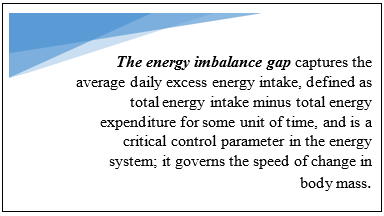 This project has developed a system dynamics model that quantifies the energy imbalance gap responsible for the US adult obesity epidemic among gender and racial subpopulations.
This study also has quantified the maintenance energy gap associated with the US adult obesity epidemic. Maintenance energy imbalance gap captures the increased energy intake needed to maintain higher average body weights compared with an initial (e.g., the early 1970s) distribution of body weight. The maintenance energy gap captures the extent of change in energy intake that is needed to turn back the obesity epidemic, and as such relates to the long-term accumulation of energy imbalance in the body mass index distribution and is often larger than the energy imbalance gap.
The important feature of our study is using an innovative method to connect a validated individual-level model of weight dynamics to population-level obesity dynamics and estimate the energy imbalance gap and maintenance energy gap associated with different gender and race/ethnicity subpopulations.
The are three phases to this study:
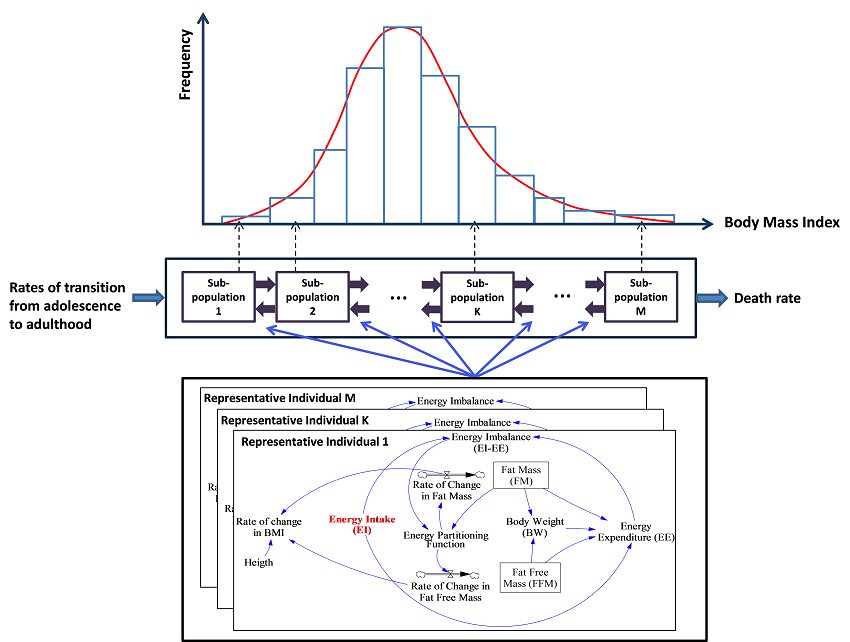
Phase one: Developing a population-level system dynamics model that captures BMI distribution and obesity prevalence
- Divided the adult population into gender–race/ethnicity subpopulations.
- Disaggregated each gender–race/ethnicity subpopulations into 14 classes corresponding to distinct BMI ranges.
- Explicitly assigned a representative individual to each of the BMI classes representing average BMI of people in the corresponding BMI classes.
- Modeled metabolism and body-weight change of representative individuals using Hall et al.’s model of human.
- Used the rate of change in the weight of each representative individual to formulate the rates by which population moves across different BMI classes.
Phase two: Modeling the energy imbalance gap
- Defined the energy imbalance gap associated with any representative individual of any BMI class in any gender/race subpopulation at any time t as a function of the equilibrium energy expenditure of that representative individual calculated at time t and an “energy gap multiplier.”
- Defined the energy gap multiplier as a function of time, body mass index of individuals, and the interaction between them.
Phase three: Calibrating the system dynamics model to estimate the energy imbalance gap
- Calibrated the model using the data from National Health and Nutrition Examination Surveys (NHANES)
- Estimated the energy imbalance gap for each gender–race–BMI group by matching simulated BMI distributions for each subpopulation against national data with maximum likelihood estimation.
- Estimated the maintenance energy gap trajectories in the past 4 decades for different gender and race/ethnicity
Highlights:
- No subpopulation showed a negative or zero energy gap, suggesting that the obesity epidemic continues to worsen, albeit at a slower rate.
- The magnitude of the drop in the energy gap in the past decade was larger in non-Hispanic Whites than non-Hispanic Blacks.
- The trend for Mexican-Americans is striking and shows no sign of abating.
- For non-Hispanic Blacks, the magnitude of the energy gap was relatively high across all BMI classes in both genders.
- Among non-Hispanic Whites, lower BMI classes face a slower upward pressure.
- Among Mexican-Americans, in the past decade, the underweight, normal, and overweight classes began to show a larger energy gap.
- The epidemic operates at varying paces across BMI classes.
- Increase in health disparities by race and ethnicity over the past ten years.
Sample Presentations:
- Fallah-Fini, S., Rahmandad, H., Huang, T., Glass, T., Bures, R., 2013, A System Dynamics Model for Estimating Energy Imbalance that Can Explain U.S. Adult Obesity Trends, Oral presentation at the 31st Annual Scientific Meeting of The Obesity Society, Atlanta, Georgia, November 11-16.
- Invited Talk at University of Southern California IPR Speaker Series
Sample Publication:
- Fallah-Fini, S., Rahmandad, H., Huang, T., Bures, R., Glass, T., 2014, Modeling U.S. Adult Obesity Trends: A System Dynamics Model for Estimating Energy Imbalance Gap, American Journal of Public Health, Special issue on Using Systems Science in Obesity Research,104 (7): 1230-1239.